


SHAC receives frequent and sometimes shocking reports about problems with service charges, leading SHAC to launch its End Service Charge Abuse (ESCA) campaign. This page brings together many of the resources and tools we have developed for all those with an interest in understanding – and ending – service charge abuse.
On this page:
Policy and Campaign Demands
Research and Evidence
- Research Reports
- The Evidence
- Our Full Evidence Bundle
- Evidence to the London Assembly’s Housing Committee
Historic Action
Resources, Help and Support
Campaign Demands
SHAC believes that tenants and residents rights should be strengthened so that they have easy access to:
- More stringent requirements on landlords to be accurate in their service charging;
- Extend the legal entitlement to service charge invoice packs to tenants;
- For service charges to be explicitly included within the remit of the Regulator of Social Housing for tenants, leaseholders and shared owners;
- Provision for tenants and residents to submit evidence of service charge inaccuracies directly to the Regulator of Social Housing;
- Restoration of Legal Aid to cover housing issues;
- Democratic control by tenants and residents when procuring goods or services from suppliers;
- The right for tenants and residents to trigger a forensic audit of their service charges if a landlord provides inaccurate service charge bills;
- An end to management fees based on a percentage of sub-contractor charges;
- Legislation to clearly distinguish between services which are included in rents and those which can be billed separately through service charges;
- Mandatory itemised billing with supplier receipts;
- Mandatory reporting through regulatory returns on overcharging and undercharging errors;
- Automatic reporting to a regulatory body when overcharging exceeds a certain level;
- Automatic compensation to tenants and residents (beyond like-for-like refunds) when overcharging occurs;
- Automatic compensation to tenants and residents when landlords are slow to reimburse tenants after overcharging;
- Set timescales for refunds;
- A mandatory requirement to pass on efficiency savings to tenants and residents when supplier costs reduce; and
- Amend Section 20B of the Landlord and Tenant Act. This is being abused by landlords who use it to bypass the proper consultation and accounting procedures originally designed to protect tenants and residents.
It is only through such measures that the system of service charging can be made transparent, and tenants and residents can be sufficiently empowered to address errors.
Key Resources for Policy Makers
Research Reports
The Evidence
Some landlords are clearly worse than others. However, across the sector it is evident that tenants and residents are getting a raw deal. Housing associations appear unable to manage this aspect of their business responsibly without stronger enforcement from government and democratic control over the provision of goods and services by tenants and residents.
“Living in an NHG shared ownership property has probably shortened my life.”
Service charge abuse victim
Many articles published on this issue tend to read as though incidents of overcharging are scattered and isolated.
But contrary to this narrative, SHAC and campaign partners Find Others have collated evidence which demonstrates that overcharging by housing association landlords is widespread and systematic. All too often it also appears deliberate; even when they are alerted to inaccuracies, they continue overcharging.
Two reports and a presentation have been produced as a result of our research. A Summary of our evidence was also presented to the Housing 2023 Conference on 29 June, A fuller version was presented to Baroness Scott and officials from the Department for Levelling Up, the National Audit Office, and the Regulator of Social Housing.
Our Full Evidence Bundle:
- SHAC – Landlord Service Charge Abuse – Tribunal Decisions 2025 Analysis of all First Tier (Property) Tribunal decisions in 2025, which found overcharging in more than 63% of cases. Housing associations were identified as the worst offenders with an overcharging rate exceeding 66%.
- SHAC – Housing Association Service Charges Abuse – Issues and Impact A report combining research by SHAC and Find Others on housing association service charge abuse and its impact on tenants and residents.
- SHAC Report on the Abuse of the Service Charge System by HA Landlords. This report maps various ways that HAs overcharge. It uses case studies, but each case typified numerous complaints reported to us by SHAC members.
- Whistleblower: Housing Association Overcharging is Deliberate – This article was written following evidence presented to SHAC by a company that manages various estates on behalf of housing associations.
- Peabody Scrutiny Panel Service Charges Report – This is a report compiled by Peabody’s scrutiny panel which investigated service charging by the landlord and found widespread overcharging and malpractice. Normally such reports are published by the landlord, but they initially refused, and it was then leaked to SHAC for publication.
- Insight on service charges and the Ombudsman’s jurisdiction – this report by The Housing Ombudsman provides insight on where landlords have gone wrong on service charges, as well as indicating which complaints can be brought to the Ombudsman. It also references some key cases from the First Tier Tribunal.
- Campaigners reveal tenants have been overcharged almost £2 million for service charges – A Big Issue article in which our campaign partners, FindOthers, reveal how they have uncovered almost £2 million in overcharges in the space of just a few months from just 27 incidents.
- Tribunals Research Finds Overcharging in 70% of Cases – SHAC researchers reviewed the 233 English First-tier Property Tribunal judgements involving tenants or residents challenging the level or payability of service charges during 2024 where an outcome had been reached. The courts removed or reduced all of the disputed charges in 67 cases (28.8%), and removed or reduced some of the disputed charges in 103 cases (44.2%). This adds to the growing body of evidence on the sheer scale of overcharging.
Evidence to the London Assembly’s Housing Committee
On the 11th December 2024, SHAC was invited to give evidence to the London Assembly’s (LA) inquiry into service charges. Originally, the Assembly’s Housing Committee (chaired by Sem Moema AM) intended to investigate only charges relating to leaseholders and shared owners, but following representations by SHAC, the inquiry’s remit was expanded to include full renters.
Our evidence stressed the commonality of problems, for all tenants and residents, the lack of regulation, the lack of accountability, and the huge enforcement gap that exists when those who have been overcharged, try to get information from the landlord or a refund.

SHAC and Other Campaign Groups Contribute to Greater London Authority Housing Report
As a result of the consultation, the GLA published its report “Worry and stress: Life as a Leaseholder in London”. SHAC’s evidence highlighted in particular the problems associated with service charges, and managed to persuade the GLA to extend the scope of their findings and recommendations beyond leaseholders and shared owners, to include tenants who also pay a separate service charge.
The final report made nine recommendations for action by the London Mayor on service charges. These are primarily focused on strengthening their service charge charter, but also include some measures (such as enhancing renters’ rights) which will be matters for government lobbying.
National Audit Office Inaction
In February 2025, SHAC, represented by the Public Interest Law Centre, presented a bundle of evidence on service charge abuse to the National Audit Office (NAO), asking them to to investigate benefits payments to landlords in respect of service charges.
To support the request, we invited MPs to sign a joint letter to the NAO backing our call. A total of 26 MPs led by Mohammad Yasin agreed. We also wrote to the NAO asking them to meet SHAC. The NAO responded on the 18th March confirming that they would meet to discuss our evidence and launch an initial investigation into the matter.
The Case to the NAO – February 2025
The case we made to the NAO concerned benefits payments processed by the Department for Work and Pensions (DWP) to cover landlord service charges. These amount to millions of pounds every year. The housing association sector alone collects around £1.7 billion in respect of service charges annually, approximately half of which is met through Housing Benefit and Universal Credit payments. Yet the DWP has no system in place to ensure that landlord service charge demands are legitimate. We know from our research that service charge accounts are riddled with errors and believe that this should be investigated.
Meeting the NAO – April 2025
On the 4th April, two SHAC representatives met the NAO Director who leads the DWP value for money work, a Senior Auditor and a Senior Audit Manager. They had read the bundle of material we had submitted.
We introduced SHAC and outlined our history and the background to the campaign. We discussed how we had collected various pieces of evidence, and they were particularly interested in the whistleblower’s submission. They also asked about our engagement with MPs and the concerns they had expressed on behalf of their constituents impacted by service charge abuse.
We were able to explain that individual tenants and residents whose service charges are covered by benefits, and who become aware that their service charge accounts were inaccurate, could not take their landlord to a Tribunal in respect of any of the service covered by benefits payments. This is because they are not directly impacted financially, and therefore not eligible to bring a case under Tribunal rules.
They are also discouraged from alerting the DWP to inaccuracies because their benefits could be cut, but the landlord would not automatically correct the errors, leaving them to make up a shortfall. This is why we need action by the NAO, DWP and government.
At the end of the meeting, the NAO officers said that they had a better understanding of our case, and that they would contact us within a month to confirm whether they will launch a full investigation.
The NAO’s Response and Strategic Legal Action
Despite the powerful evidence collated by SHAC and presented by PILC, the NAO has declined to investigate the abuse of the public purse, saying that service charge abuse was a matter for regulation.
SHAC Appeal to the NAO – April 2026
After conducting research into Housing Benefits and service charges, we sent a second request to the NAO to investigate and attached our data. We emphasised that together, our research demonstrate grounds for concern, a systemic failure of oversight, and a substantial loss of public funds. We reiterated our request that the NAO launches an investigation into service charge abuse and the Housing Benefit system. Our call was supported by John McDonnel, MP for Hayes and Harlington.
The NAO responded on the 5th May 2026, once again declining to investigate, but acknowledging that the new information raises “an important issue” and that “there are questions to ask of the Department for Work & Pensions (DWP) and what it understands about the service charges it is covering through benefit payments.” The NAO therefore stated that they will “follow up with DWP to find out in more detail what data it collects on this matter and to establish whether there have been any changes to its oversight of service charges since we spoke to officials last year.” They have promised to write to SHAC again once they have completed their inquiries.
SHAC Petition
A SHAC petition on the parliamentary website reached more than 12,500 signatures and allowed us to significantly raise awareness amongst MPs of the widespread concern about extortionate and inaccurate service charging. See the previous petition here.

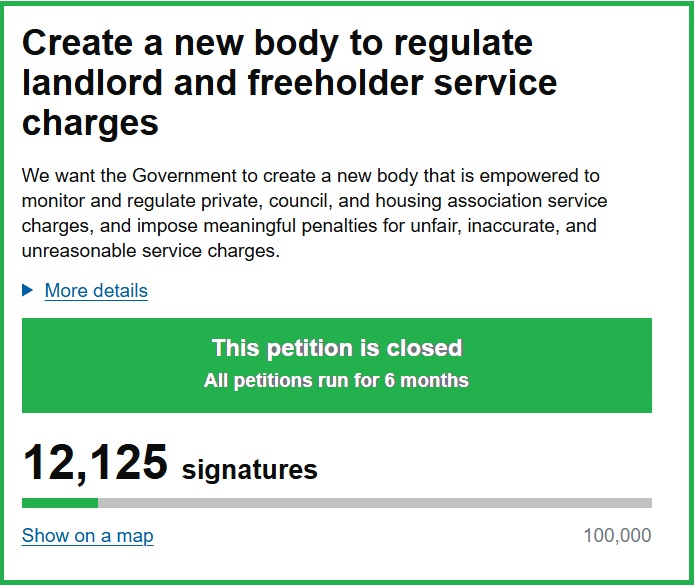
On the 19th May, government responded to the petition. Read the response here. Our reaction can be found here. Further Action: if you are a trade union member, you will be allocated to a branch. Please therefore take our trade union model motion to your next branch meeting to help raise awareness of the campaign and specifically the petition.
Open Letter by MPs
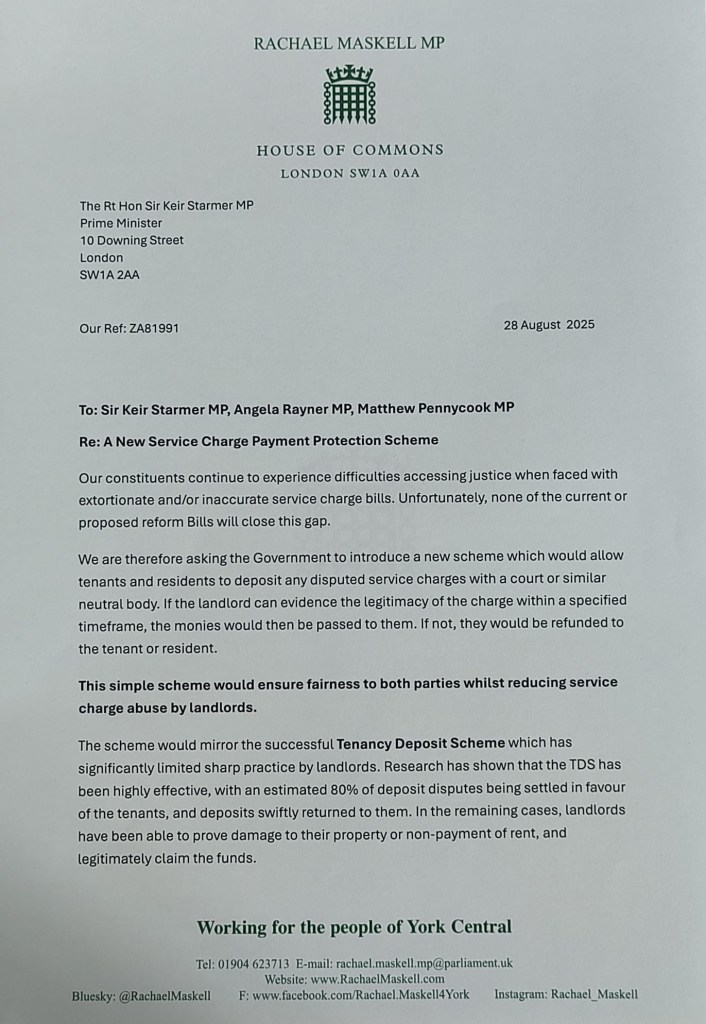
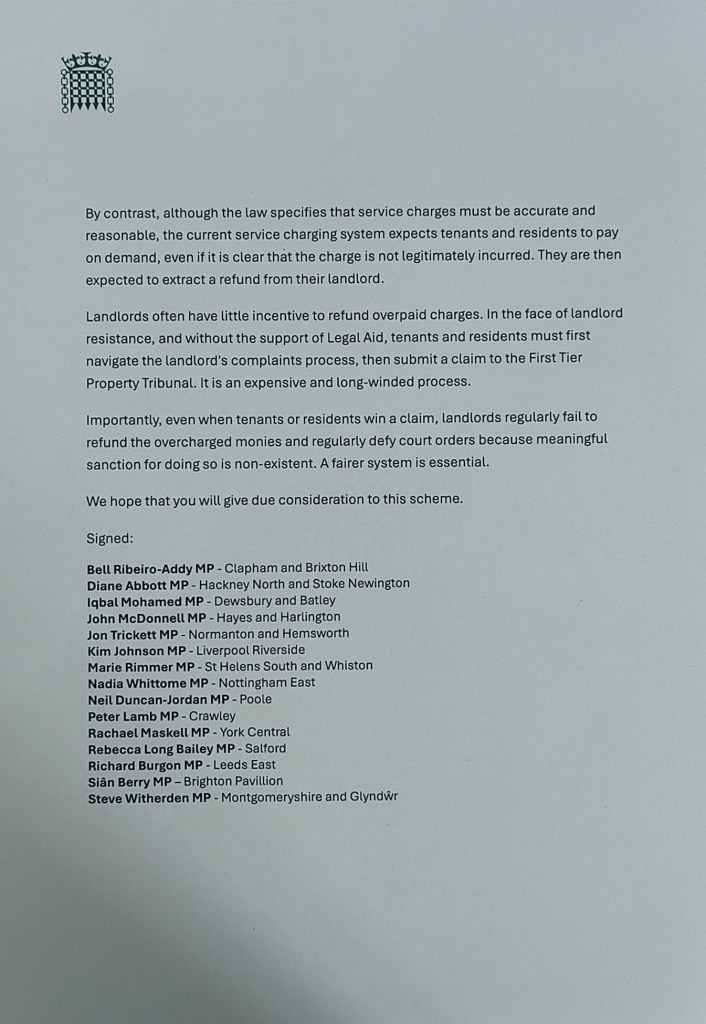
SHAC received support for the fast-track service charge dispute scheme from Rachael Maskell MP and 14 other MPs who signed an open letter to the Government.
Lobbying MPs
MPs need to be made aware of the problems caused by service charge abuse. They need to hear this from their own constituents so that they will support the legal reforms needed.
To make it quick and easy, we have created a template text for you to download and send to your MP with the attachments outlining the legal changes needed and Parliamentary Questions that MPs can draw on to raise the profile of service charge abuse.
Just replace the red text with your details then copy the message into an email together with the legal changes and Parliamentary questions documents:
You can find your local MP here:
Please take a few moments to take this one action and open the political doors. We cannot win this fight without changing the laws.
Parliamentary Questions on Service Charge Abuse
Parliamentary questions posed by sympathetic MPs have helped raises the profile of service charge abuse, and of SHAC’s work to end it. For example, on the 11th November, Rachel Gilmour, MP for Tiverton and Minehead tabled two questions:
- Given SHAC’s evidence on service charge abuse by all tenures of landlord – private, council, and housing association – will the Government now legislate to standardise service charge line item descriptions, terminology used, and include references to the Schedule of Rates codes, and to regulatory standards where applicable, for example BS EN ISO numbers?
- And legislate to prohibit the imposition of non-disclosure agreements on those who successfully challenge their landlord and/or managing agents over aspects of service charges or major works bills, and who agree an out-of-court settlement?”
On the 15th November, Neil Duncan-Jordan, MP for Poole, tabled five questions:
- To ask the Secretary of State for Housing, Communities and Local Government, if she will bring forward legislative proposals to require landlords and managing agents to pay automatic compensation to tenants when overcharging occurs.Legislate for service charge arrears to be treated as arrears and not result in forfeiture?
- To ask the Secretary of State for Housing, Communities and Local Government, if she will make it her policy to pay automatic compensation to all tenants when landlords and managing agents are slow to reimburse tenants after overcharging?
- To ask the Secretary of State for Housing, Communities and Local Government, if she will bring forward legislative proposals to cap service charge rises annually at the rate of CPI inflation?
- To ask the Secretary of State for Housing, Communities and Local Government, if she will bring forward legislative proposals to extend to ten years the time limits for tenants and residents to request invoices and receipts in relation to service charges?
- To ask the Secretary of State for Housing, Communities and Local Government, if she will bring forward legislative proposals to require (a) all service charge accounts to be audited every year by independent accountants and (b) that the cost of this audit cannot be passed onto residents through service charges?
Challenge the Charges
Withhold Payment of Disputed Amounts
Many tenants and residents are choosing to withhold payment of disputed amounts (starting a service charge strike). If you decide to take this path, SHAC is able to provide support. We would recommend a number of steps to make sure that it is done as safely as possible and to make it harder for the landlord to retaliate with legal threats. If you can do so with others from your estate or neighbourhood, the strike will be more powerful.
Our advice and guidance on rent and service charge strikes can be found here.
Demand a Forensic Audit
We have been lobbying housing associations to carry out forensic audits based on a sample of three estates, preferrably chosen with SHAC’s involvement.
To support ths process, we have produced a Forensic Service Charge protocol after being asked to do so by one of the larger housing associations. The protocol has been written in a way that makes it applicable to all landlords, whatever their size.
If you are having service charge issues, please feel free to send it to your landlord and ask them to use this protocol to check your accounts (click the image to download the document).
Help and Support
For practical tools, see the SHAC Resources section which includes guides on challenging service charge inaccuracies, templates, suggestions for organising others, and advice on taking a case to First Tier Tribunal. You can also use our service charge costs template to keep track of charges relating to individual properties, blocks, and estates.
Our Members’ Voices
SHAC member Francesco speaks on rising and inaccurate service charges (he reclaimed over £15K for his estate), the declining standards of service, and the difficulties of engaging with his landlord. It’s why we’re campaigning so hard to #EndServiceChargeAbuse.
If you are affected by service charge abuse, please keep checking our regular newsletter and on this page for further details on how to submit your experiences.


To join SHAC and support our campaigns, please use our registration form here.